Maokong Tea: What It Is, Where It Grows, And How To Buy It
Maokong grows two teas you will struggle to find anywhere else in Taiwan: Muzha Tieguanyin and Wenshan Baozhong. This guide covers the hillside's tea history, the plantations you can walk through, the center that explains it all, and what to pay when you buy.
Short answer
Maokong tea means two oolongs grown on the Wenshan hillside: Muzha Tieguanyin, cultivated nowhere else in Taiwan, and Wenshan Baozhong. The plantations sit at roughly 300 to 500 metres and are picked twice a year, in spring and late autumn. Leaf is sold at the Taipei Tea Promotion Center and at farm shops along Zhinan Road; expect competition-grade Tieguanyin to cost more than everyday drinking grades.
Sitting down to drink tea in a Maokong teahouse and buying leaf to carry home are two different jobs, and this guide is deliberately about the second one. The hillside above the gondola's top station is one of the most distinctive tea landscapes in Taiwan: it is the only place in the country where Tieguanyin is cultivated, and the origin of the name Wenshan Baozhong, which is now used for tea grown across a whole region of northern Taiwan. The plantations are small, family-run and walkable, and the story of how they got there starts with one man carrying twelve seedlings across the water from Fujian in 1895.
If you want the drinking side of things, the teahouse guide covers where to sit and what to order. This page is about the leaf itself, the people who grow it, and how to buy it without overpaying.
What Is Maokong Tea?
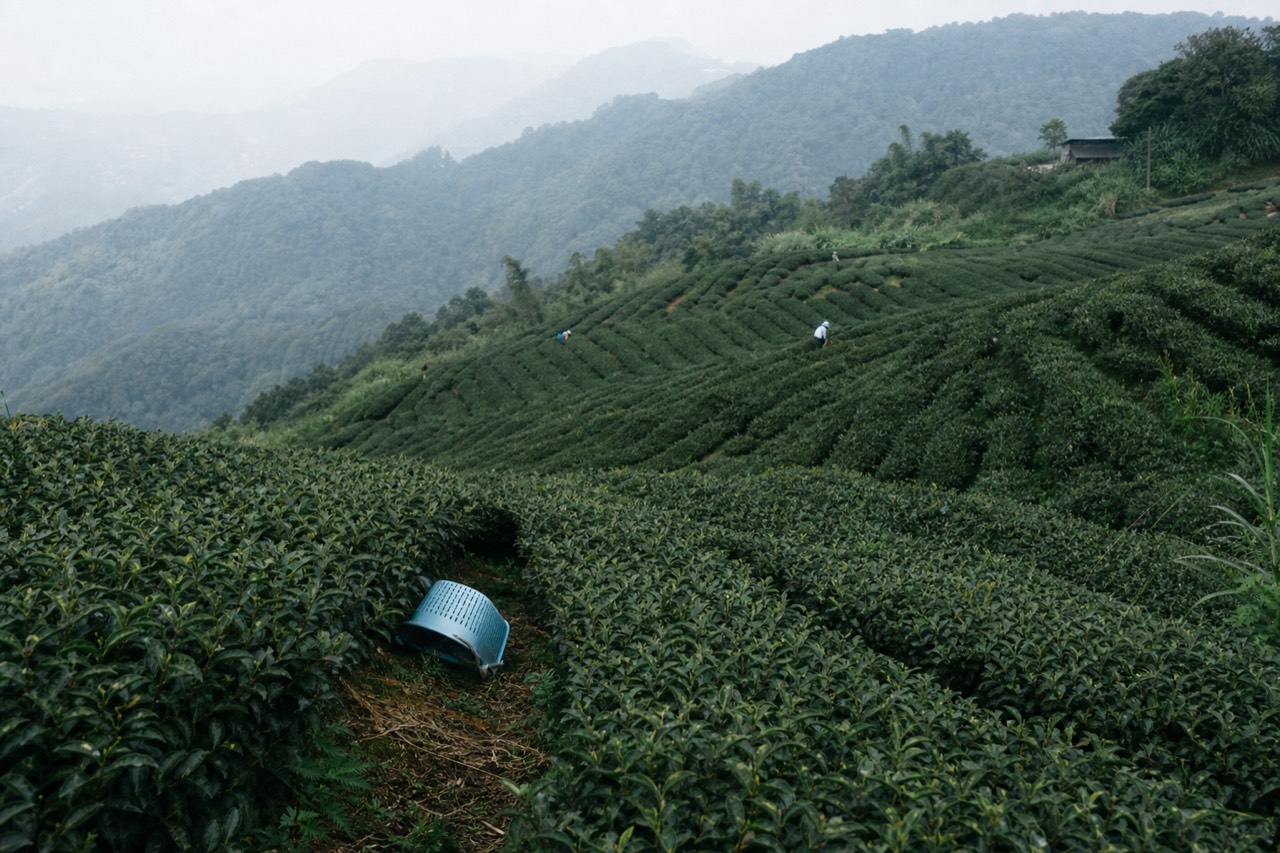
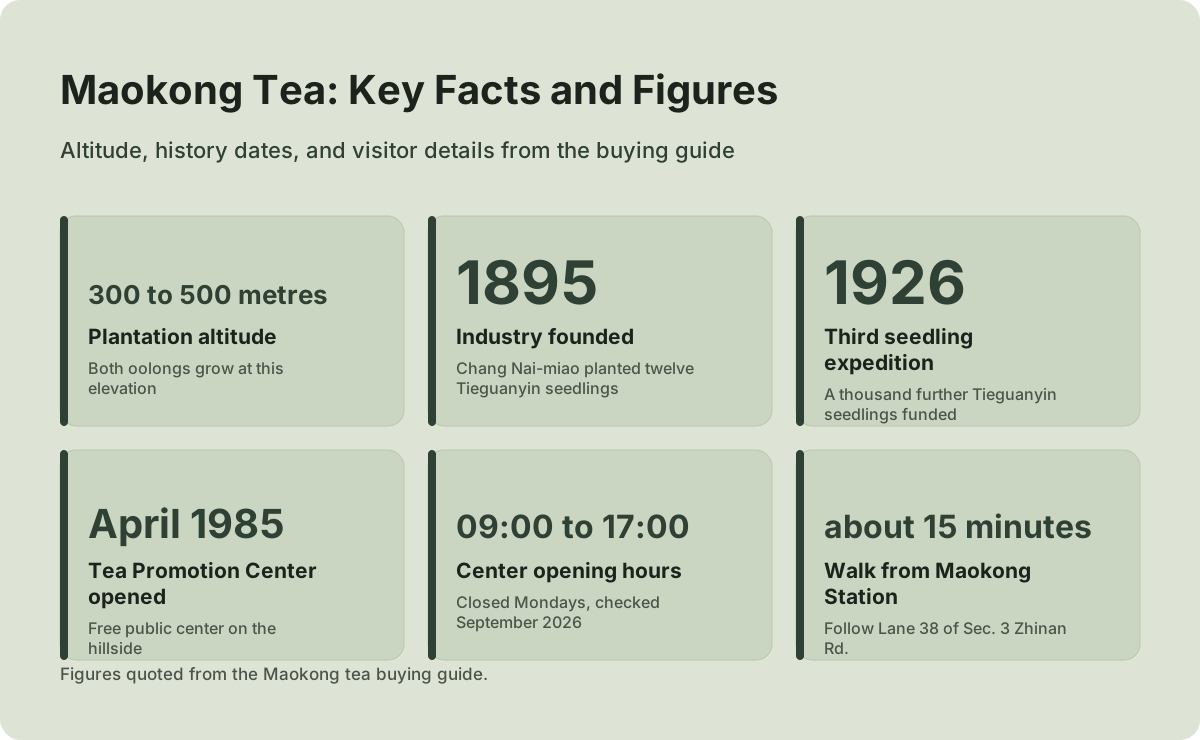
Maokong tea is not a single tea but a pair of oolongs grown on the same hillside: Muzha Tieguanyin, a slow-roasted, deeply aromatic oolong that is cultivated nowhere else in Taiwan, and Wenshan Baozhong, a lightly oxidised, floral tea whose name now covers a whole growing region that started here. Both grow on plantations at roughly 300 to 500 metres above sea level, and both are picked twice a year rather than year-round.
The two teas could hardly be more different in the cup. Tieguanyin is the heavier of the pair: the traditional Muzha style involves slow charcoal roasting, which gives the leaf a dark, almost nutty depth and a finish that lingers. Baozhong is the opposite, barely twisted, lightly oxidised, drunk for its fresh, orchid-like fragrance. Growers on this hillside produce both, often on adjacent plots, and most farm shops will pour you a taste of each before you commit to buying.
The reason both grow here is geography plus history. The hills of the Wenshan district sit at altitudes of roughly 300 to 500 metres, on slopes whose climate and soil conditions match those of Anxi in Fujian, the original home of Tieguanyin. That match is why a Fujian tea took root so successfully on a Taipei hillside, and why it never spread across the rest of the island in the same way. Muzha is, in the operator's own plain statement, the only place in Taiwan where Tieguanyin is cultivated.
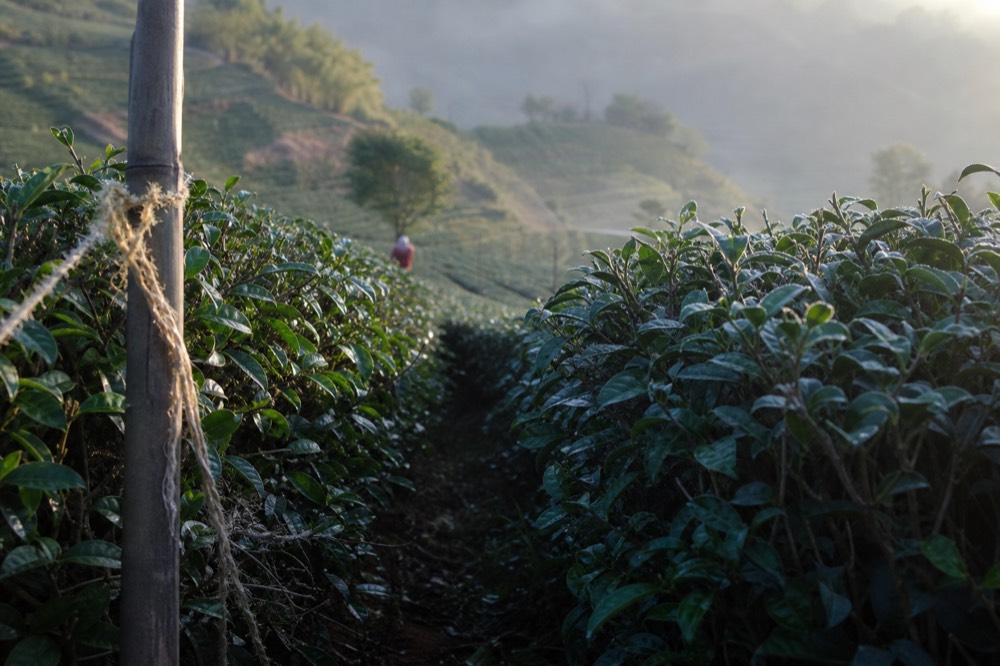
The name of the hillside itself has nothing to do with any of this, incidentally. The place is not named after cats, despite the characters; the operator's own account is that the streambed is riddled with potholes locals called liâu-khang in Hokkien, and Japanese-era surveyors wrote it with the phonetically similar characters that stuck. The meaning of Maokong is a story worth knowing before you buy a tin with a cat on it.
Where Did Maokong's Tea Come From?
Maokong's tea industry began in 1895, when tea master Chang Nai-miao brought twelve Tieguanyin seedlings from Fujian and planted them in the Zhanghu area of Muzha. He was then hired as the Taipei Prefecture travelling tea master for ten years, teaching Baozhong and oolong technique across the wider Wenshan area, which is why the region's tea carries the Wenshan Baozhong name to this day. A third expedition in 1926 brought a thousand more seedlings.
Chang's story is the single best piece of context for anything you buy on this hillside. Twelve seedlings is a vanishingly small start for an industry, and the fact that Muzha Tieguanyin still exists at all is down to those plants taking, and to Chang spending a decade teaching his methods across what was then Wenshan County, an area covering Muzha, Jingmei, Shenkeng, Shiding, Xindian and Pinglin. The Baozhong tea that region is now famous for grew out of that teaching circuit.
The third chapter came in May 1926, when Chang travelled again to Wuyi and Anxi under the Wenshan Tea Company, with Chang Fu-tang and Cheng Tsai-lai funding a thousand further Tieguanyin seedlings. That is the point at which the plantation area you walk through today really took shape.
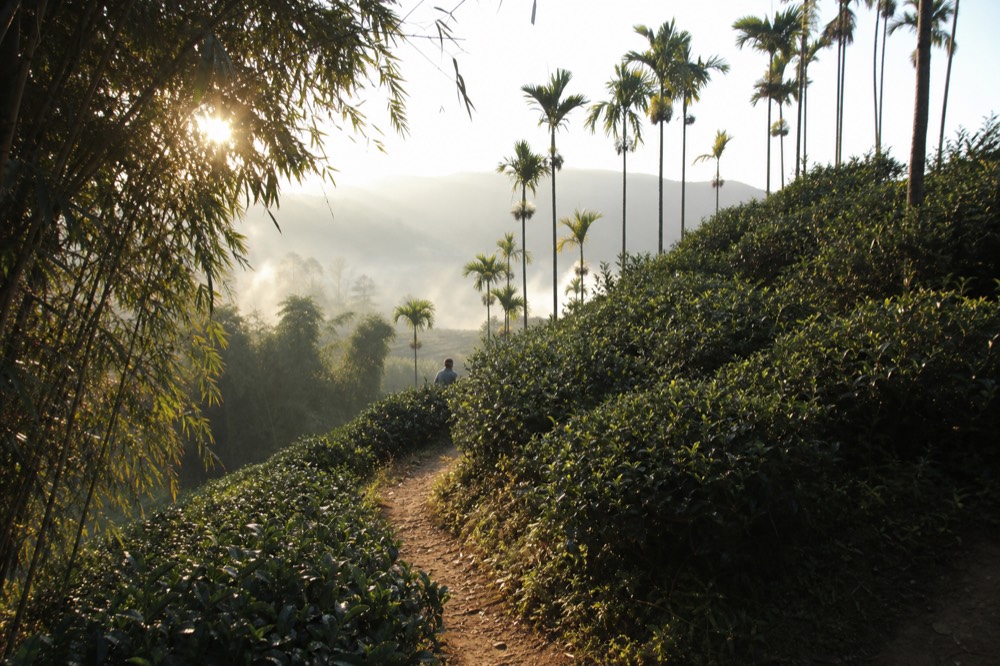
His legacy is preserved in a physical place you can visit. The Chang Nai-miao Memorial Tea Museum was established in 1995 and is run today by his grandson, Chang Wei-yi. The ground-floor tea room is free to enter, admission is charged for the second floor, and the address is No. 53-2, Lane 34, Sec. 3, Zhinan Rd. If you want to understand what you are drinking before you spend money on leaf, this is the most direct route.
If you are still sorting out how you will actually get up the hill, here are the ticket options that pair well with a tea-buying day:
The one-day pass in particular suits a tea trip, because it covers all four passenger stations and lets you break your journey at Zhinan Temple or the zoo's south side without paying again.
How Much Should Maokong Tea Cost?
There is no single published price for Maokong tea, and no operator or government body sets one, so treat any number a shop quotes as a negotiation between grade and season rather than a fixed fact. What can be said firmly is the structure: everyday drinking grades of Baozhong cost noticeably less than Tieguanyin, competition-winning Tieguanyin sits at the top of the range, and the spring and winter picks command premiums over other times of year.
The honest answer about price is that you are buying an unbranded agricultural product from small producers, and prices vary plot to plot and season to season. What you can do is buy with the shape of the market in your head. The table below sets out the planning ranges as a guide to what to expect, not as promises; always confirm the price of the specific tin in front of you before paying.
| Tea and grade | What to expect | Planning range (check the room) |
|---|---|---|
| Wenshan Baozhong, everyday drinking grade | Light, floral, the everyday tea of the hillside | Lower end of the range |
| Muzha Tieguanyin, standard roast | The traditional charcoal-roasted style | Mid range |
| Muzha Tieguanyin, higher roast or older leaf | Deeper, more concentrated | Upper mid range |
| Competition-award Tieguanyin | Competition-winning lots, small quantities | Top of the range |
One local producer gives a useful signal about what "top of the range" means here. Maokong Tea Master took gold, silver and general awards in the 2025 Winter Tieguanyin Excellent Tea Competition, announced in December 2025, and repeated the feat in the 2025 spring competition. Award lots like these are sold in small quantities and priced accordingly; if a shop is quoting award-level prices, it is fair to ask which competition and which year.
A practical rule for a fair deal: taste before you buy, ask which season the leaf is from, and be suspicious of a single "Maokong tea" price that does not distinguish Baozhong from Tieguanyin. Any grower proud of their leaf will pour you both. The drinking side, covered separately, rewards the same patience.
Where Can You Buy Tea In Maokong?
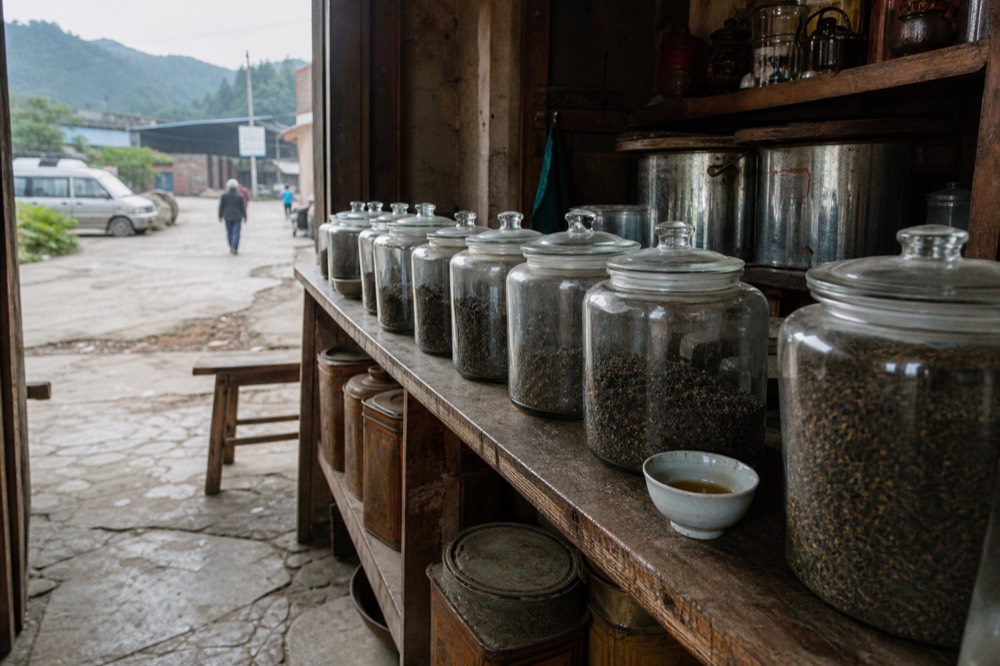
The three main places to buy leaf are the farm shops and stalls clustered along Zhinan Road Sec. 3 near Maokong Station, the Taipei Tea Promotion Center for Tieguanyin and Baozhong, which sells and explains the local teas, and the Chang Nai-miao Memorial Tea Museum, where the grandson of the man who founded the industry serves tea from the ground-floor room. Each suits a different kind of buyer.
The farm shops are the largest category by far. Walk out of Maokong Station and the tea-growing area spreads along Zhinan Road and its lanes; the Circular Tea Trail from the station leads left to the Tea Promotion Center in about 15 minutes, and the Zhanghu Trail loops through terraced tea gardens you can walk before you buy. Buying at the farm means the person pouring your tasting cup is usually the person who grew and roasted the leaf.
The three buying venues compared:
| Venue | Best for | Notes |
|---|---|---|
| Farm shops along Zhinan Rd. Sec. 3 | Tasting widely, buying direct from growers | Spread along the lanes near Maokong Station |
| Taipei Tea Promotion Center | Understanding the teas before buying | Open daily 09:00 to 17:00, closed Mondays |
| Chang Nai-miao Memorial Tea Museum | History with your cup | Ground-floor tea room free; second floor charged |
A note on timing your buying trip around the rest of the hillside: the gondola itself closes on most Mondays for maintenance, and the exact Mondays vary month to month, so check the operator's published calendar before planning a Monday visit. The Tea Promotion Center is separately closed every Monday regardless.
What Is The Taipei Tea Promotion Center?
The Taipei Tea Promotion Center for Tie Guanyin and Bao Zhong Tea is a free public center on the hillside that explains how Muzha Tieguanyin and Nangang Baochong are grown and processed, with an exhibition area on production, a teaching area, an ecological pond, a weather observation platform, an artificial rainfall erosion trough and a working tea plantation. It opened in April 1985 under the Taipei City Farmers' Association and was renamed in 1999.
For a buyer, the center is the most efficient hour on the hillside. The exhibition area walks through the production process for both local teas, which makes the price differences you encounter in the farm shops suddenly make sense: charcoal roasting is slow, skilled work, and the center shows you exactly what it involves. The working plantation out back lets you see the bushes, the picking rows and the terrain before you spend anything.
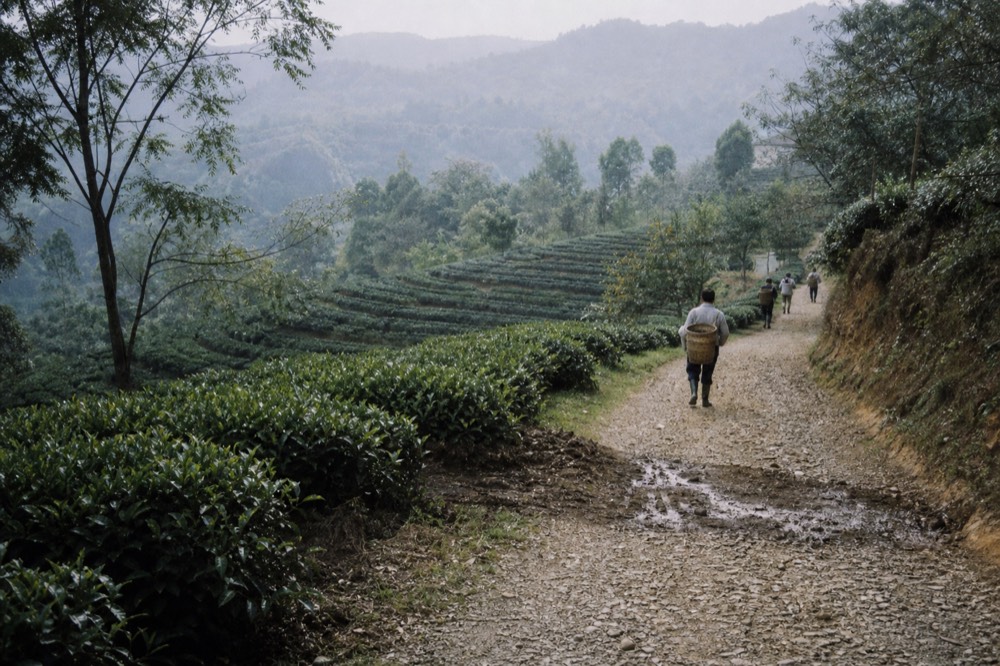
Practical details: the center is at No. 8-2, Lane 40, Sec. 3, Zhinan Rd., Wenshan District, open daily 09:00 to 17:00 and closed Mondays. From Maokong Station, turn left out of the station and follow Lane 38 of Sec. 3 Zhinan Rd. towards Tianen Temple; the walk is about 15 minutes. Tianen Temple itself, an I-Kuan Tao hall further along, sells vegetarian cakes and tea snacks if you want something to eat alongside your tasting.
When Is Maokong Tea Harvested?
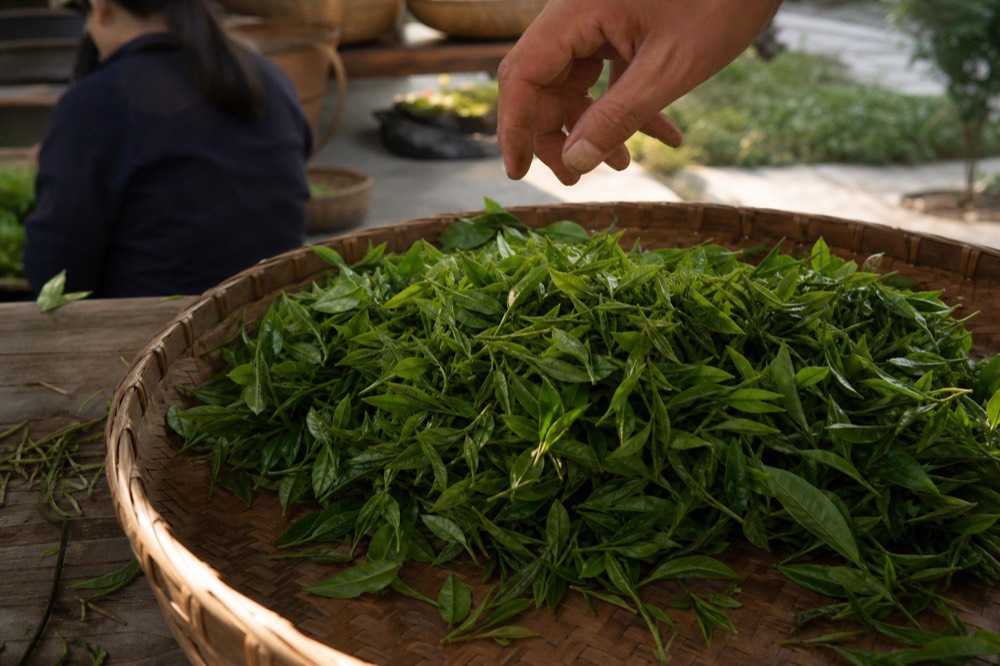
Maokong tea is picked twice a year, not continuously: the spring harvest falls around April to May and the autumn and winter harvest around November to December. The operator's own seasonal calendar for the hillside lists spring tea in May and June, bamboo shoots in May and June, and the winter solstice period as the time of the annual tea sealing ceremonies. Spring and winter picks are the two most sought after.
The two-pick rhythm matters to a buyer more than to a drinker passing through. Leaf sold between harvests is from stored lots; leaf sold shortly after a pick is fresher, and growers will tell you which you are getting. The spring pick around April and May is the celebrated one for Baozhong, while the winter Tieguanyin competition, the one Maokong Tea Master won in 2025, is judged on the late-year pick.
The hillside's seasonal calendar, as published by the gondola's operator for the wider Maokong area:
| Season | What is happening on the hillside |
|---|---|
| January to February | Apricot blossom in the Apricot Blossom Grove |
| February to March | Lupin season on the operator's seasonal calendar; its Camphor Tree Trail page dates the field itself to late March and early April |
| April to May | Tung blossom along the upper trails |
| May to June | Bamboo shoots; spring tea |
| Around the winter solstice | Tea sealing ceremonies, winter tea |
There is also a cultural layer to the winter pick: seasonal events in Maokong include the annual tea harvest festival and tea sealing ceremonies held around the winter solstice, and a tea-sealing gratitude event was held on 9 August 2025 for Father's Day. Sealed tea, tea pressed and closed in a container to age, is one of the more distinctive things you can buy here, and some of the pricier bundled gondola options include a sealed-tea DIY session. Note that there is no teahouse dining voucher in any of them; the bundled extras are small experiences, a temple prayer card or a sachet of Tieguanyin, plus a discount booklet.
What Are The Charcoal Kilns On The Tea Trail?
The charcoal kilns on the Camphor Tree Trail are restored stone structures where Maokong's tea roasting was historically fired, using lychee, longan and acacia logs held at 350 to 1,050 degrees for about two weeks to make charcoal, then sealed to smoulder for a further 5 to 10 days and cooled for about 10 days before opening. They were restored by the city's Geotechnical Engineering Office and stand beside the trail today.
This is the piece of the tea story that ties everything else together. Traditional Muzha Tieguanyin is charcoal roasted, and the charcoal came from these kilns. The method is slow to the point of ceremony: the logs dehydrate and carbonise at 350 to 1,050 degrees over roughly two weeks, the kiln mouth and flue are sealed with clay and stone, the wood smoulders on residual heat for 5 to 10 days, then the kiln cools for about 10 days before it can be opened. That is why charcoal-roasted tea carries the price it does, and seeing the kilns makes the reasoning physical.
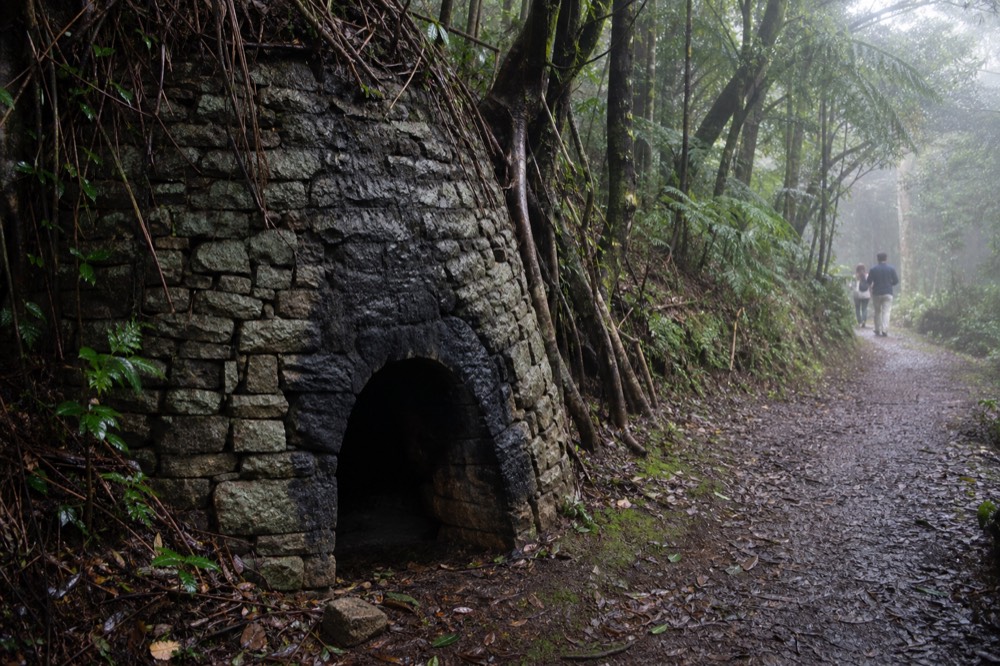
The Camphor Tree Trail itself is about 1.5 km and takes roughly 30 minutes one way; the operator describes it as Taipei's first fully level trail, comfortable for older visitors and small children. It is lined with restored rural pieces, the kilns plus a pigsty, ox cart and granary, and in late March to mid-April its 1.5-hectare lupin field flowers yellow, white and blue, which the operator calls the only lupin field of its kind in Taiwan. The hiking trails guide covers the other seven signposted routes if you want a longer loop through the gardens.
How Do You Get To The Tea Plantations?
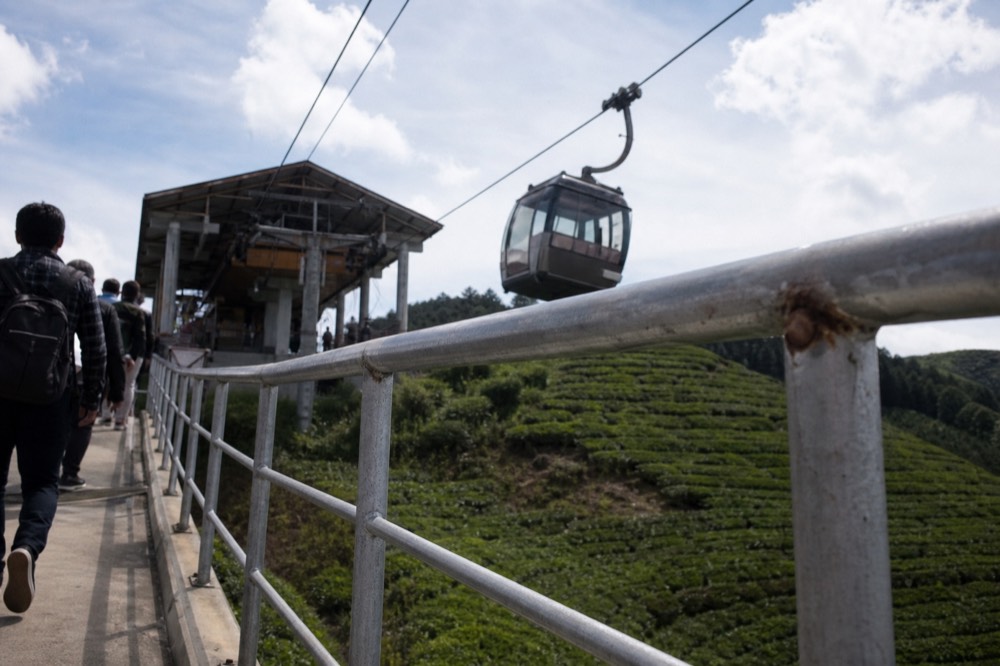
You reach the tea plantations via the Maokong Gondola from Taipei Zoo Station, about a 350-metre walk from the MRT on the Wenhu Line. From the top terminus at Maokong Station, the Circular Tea Trail leads left to the Tea Promotion Center in about 15 minutes, with farm shops spreading out from there. A one-day pass covers all four passenger stations, so you can hop off at Zhinan Temple or the zoo's south side on the way.
The standard route for a tea-buying day is simple. Take the MRT Wenhu Line to Taipei Zoo Station, walk about 350 metres southwest along Xinguang Rd. Sec. 2 to the gondola, and ride to the top. The full ride takes about 20 to 30 minutes at normal speed, up to roughly 37 minutes when the system runs slow. Once at Maokong Station, everything in this guide is on foot or a short bus hop. The Maokong Gondola is the practical backbone of any tea-buying itinerary, because the alternative roads up the hill are narrow farm tracks that the city itself has described as congested on holiday weekends.
Getting around once you are up there:
| Option | What it covers |
|---|---|
| Circular Tea Trail | Maokong Station to the Tea Promotion Center, about 15 minutes on foot |
| Maokong Tour Bus Right Line | Loops past the Camphor Tree Trail entrances, Zhangshan Temple and the Apricot Grove; free to gondola riders the same day |
| Camphor Tree Trail | About 1.5 km, roughly 30 minutes, Taipei's first fully level trail |
The tour bus detail is worth underlining: gondola ticket holders can ride the Maokong Right Line and Left Line buses for free on the same day, a rule that has applied to all riders since the March 2025 fare change. The Right Line runs weekdays 09:00 to 20:00 and weekends and holidays 08:30 to 20:00, but after 19:00 there are only three departures, at 19:00, 19:30 and 20:00. If your tea buying runs past sunset, plan around those last buses or walk back down the trail.
The day pass is the natural fit for this itinerary, and it is the one ticket that lets you ride back down after a full afternoon on the hillside:
The pass is open-dated and valid for 180 days, and it is genuinely unlimited on the day you activate it, so a morning in the plantations and an afternoon at the zoo or the temple fit on one ticket. Children aged 0 to 5 ride free with a ticketed adult, up to two per adult.
What Should You Know Before You Buy?
Before buying leaf in Maokong, know three things: taste before you pay and ask which season the leaf is from, distinguish Baozhong from Tieguanyin because they sit at different price points, and remember that the hillside's award lots are small and seasonal, so a competition claim should come with a year attached. Buy from the grower where you can, and carry leaf home in a sealed tin rather than a paper bag.
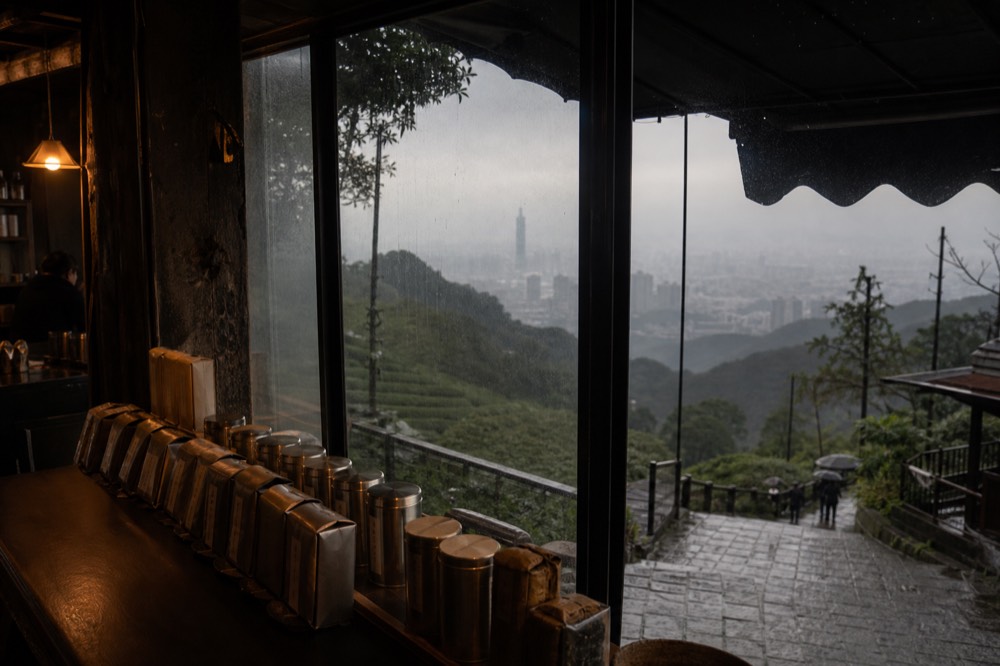
A few closing practicalities. The plantations are working farms, so stick to the signposted trails, the eight of them being Huxue, Xiao Tiankong, Houshanyue, Zhanghu, Zhinangong, Zhangshu, Feilong and Denggao, rather than cutting through the bushes. The operator publishes no real-time crowd indicator, so the honest way to beat queues is the online booking system, particularly for the Crystal Cabin, which is an on-site upgrade of NT$50 per person per trip on top of whatever ticket you hold. And if weather closes the system while you are up the hill, passengers stranded at the upper stations are taken back down by free shuttle buses, so a weather stoppage does not strand you.
For the wider picture of what else the hillside offers, the free things to do in Maokong guide collects the viewpoints, trails and temples that cost nothing.
If you are comparing tickets for the trip up, these are the three options most tea-buying visitors weigh:
These are the questions buyers ask most often about leaf, prices and the plantations, answered from the operator's own published material and the hillside's competition records. Each answer below is short and practical, so you can check a single point quickly before or during your trip.
Common Questions About Maokong Tea
What Is Maokong Tea?
Maokong tea is a pair of oolongs grown on the Wenshan hillside: Muzha Tieguanyin, a charcoal-roasted tea cultivated nowhere else in Taiwan, and Wenshan Baozhong, a light, floral tea whose regional name originated here. The plantations sit at roughly 300 to 500 metres and are picked twice a year, in spring around April to May and again around November to December.
Where Can I Buy Tea In Maokong?
Buy at the farm shops and stalls along Zhinan Rd. Sec. 3 near Maokong Station, at the Taipei Tea Promotion Center (open daily 09:00 to 17:00, closed Mondays), or at the Chang Nai-miao Memorial Tea Museum, where the founder's grandson runs the ground-floor tea room. Tasting before buying is normal practice at all three.
How Much Does Maokong Tea Cost?
There is no fixed published price. Everyday Baozhong sits at the lower end of the range, standard-roast Tieguanyin in the middle, and competition-award Tieguanyin at the top. Ask which season the leaf is from and which competition any award claim refers to before paying.
Who Brought Tea To Maokong?
Tea master Chang Nai-miao brought twelve Tieguanyin seedlings from Fujian in 1895 and planted them in the Zhanghu area of Muzha. He then spent ten years as the Taipei Prefecture travelling tea master, teaching across the Wenshan area, and in 1926 a further thousand seedlings were funded and planted.
When Is The Best Season To Buy Maokong Tea?
The two harvests are spring, around April to May, and autumn and winter, around November to December. Leaf bought shortly after a pick is fresher; the winter Tieguanyin competition lots are the most celebrated, and tea sealing ceremonies are held around the winter solstice.
Can You Walk Through The Tea Plantations?
Yes. The Circular Tea Trail leads from Maokong Station to the Tea Promotion Center in about 15 minutes, and the Zhanghu Trail loops through terraced tea gardens. Stick to the eight signposted trails, as the plantations are working farms.